


Your shopping cart is empty!
English Daisy "Ekstra Mix"
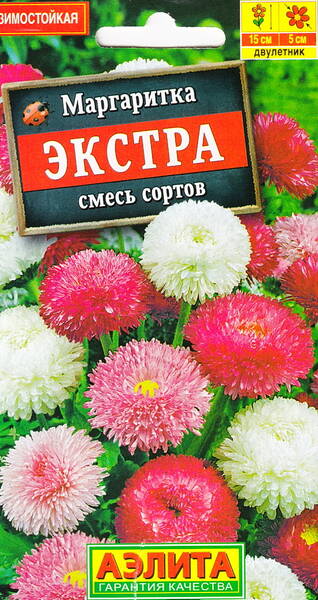
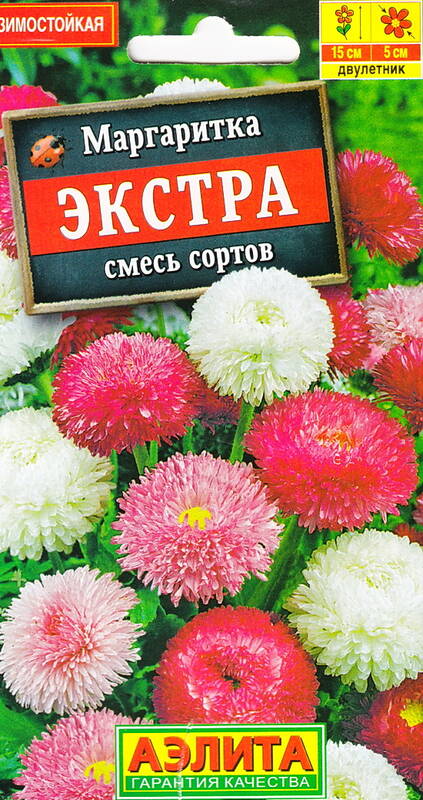
English Daisy "Ekstra Mix".
A hardy biennial. It is distinguished by very early blooming, starting from late April. If the plantings are covered with clear film in early spring, you can achieve super-early blooming in the first or second ten days of April.
The bushes are compact, 15 cm high. The inflorescence-baskets are densely double, up to 5 cm in diameter. English daisies combine perfectly with early-flowering bulbous plants – tulips, daffodils, and hyacinths.
Recommended for container growing, carpet bedding, and borders in flower gardens.
Growing a daisy from seeds is not difficult at all. Its small seeds (up to 7,000 pcs in 1 g) retain good germination for at least three years and usually sprout amicably a week after sowing. Daisies are sown in June-July, and seedlings are pricked out 2 weeks after emergence.
In the garden, the daisy actively reproduces by self-seeding. If you do not regularly remove the fading inflorescences, young seedlings will soon appear in a thick brush around the mother plant. These seedlings can also be pricked out or transplanted. However, with such «wild» propagation without selection, the plants will begin to lose their decorative qualities and gradually degenerate into small-flowered, almost wild forms with single petals. Moreover, daisies can easily escape onto the lawn. It will be difficult to get rid of them there: the leaf rosettes pressed tightly to the ground are simply not captured by the lawnmower, so they will have to be removed manually by the roots.
A hardy biennial. It is distinguished by very early blooming, starting from late April. If the plantings are covered with clear film in early spring, you can achieve super-early blooming in the first or second ten days of April.
The bushes are compact, 15 cm high. The inflorescence-baskets are densely double, up to 5 cm in diameter. English daisies combine perfectly with early-flowering bulbous plants – tulips, daffodils, and hyacinths.
Recommended for container growing, carpet bedding, and borders in flower gardens.
Growing a daisy from seeds is not difficult at all. Its small seeds (up to 7,000 pcs in 1 g) retain good germination for at least three years and usually sprout amicably a week after sowing. Daisies are sown in June-July, and seedlings are pricked out 2 weeks after emergence.
In the garden, the daisy actively reproduces by self-seeding. If you do not regularly remove the fading inflorescences, young seedlings will soon appear in a thick brush around the mother plant. These seedlings can also be pricked out or transplanted. However, with such «wild» propagation without selection, the plants will begin to lose their decorative qualities and gradually degenerate into small-flowered, almost wild forms with single petals. Moreover, daisies can easily escape onto the lawn. It will be difficult to get rid of them there: the leaf rosettes pressed tightly to the ground are simply not captured by the lawnmower, so they will have to be removed manually by the roots.
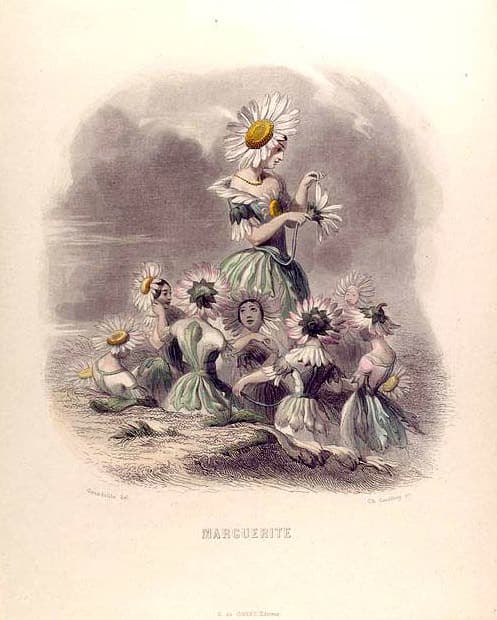
Grandeville.
The name "margarita" (daisy in many languages) comes from the Greek word margarites, which means "pearl". This name suits the flower very well: small, bright flowers scattered on a green carpet truly resemble the beads of a necklace that fell from the neck of some beauty. Pliny the Elder gave the daisy its generic Latin name: Bellis - beautiful. And these pearls are indeed beautiful!
There are several beautiful legends about the origin of the daisy on earth.
Here is one of them: they say that a rich old man fell in love with a very beautiful girl. He chased her everywhere, gave rich gifts to her parents so that they would give him their daughter. The girl ran away, hid from him and, finally, having lost hope for salvation, asked the earth for protection, and the earth turned her into a daisy, blooming almost all year round.
Another legend is connected with the earthly life of the Virgin Mary. The Holy Mother of God wanted to please little Jesus one winter day. But she did not find a single flower in the snow and decided to make it herself. From sparkling silk and threads, the Virgin sewed daisies. Jesus liked them very much, and he carefully kept them with him all long winter. And when spring came, little Jesus planted them in the ground and began to water them. The flowers began to grow and bloomed all over the earth, and there was no place left where they could not be found. For many nations, the daisy has long been an emblem of kindness and cordiality, and in the language of flowers, it means purity, innocence, and true love. Legends, traditions, and spring holidays are associated with it.
The daisy was especially popular in Europe in the Middle Ages. Noble knights decorated goblets with daisies, from which they drank wine in honor of the arrival of Spring. It was also customary to decorate the statues of the Goddesses of Spring with daisies - this was considered the most worthy and pure decoration.
The French King Louis IX (1214-1270), who led the campaigns of the crusading knights, ordered a special ring to be made for himself in honor of his wife Margaret of Provence, which depicted a wreath of intertwined daisies and lilies. By the way, we can even speak of a certain custom that existed in the royal houses of Europe, according to which it was considered the height of elegance to give noble ladies named Margarita expensive jewelry and trinkets depicting a daisy, playing on the sameness of the names in puns and madrigals. In England, the daisy enjoys universal folk love and is praised in many songs. The poet James Montgomery said of it: "The rose has but a summer reign, the daisy never dies." And indeed, in the mild and damp climate of England, a blooming daisy can be seen almost all year round.
Daisies look great in pots and flower containers, they perfectly harmonize with such spring flowers as: snowdrops, crocuses, as well as pansies, forget-me-nots, and botanical tulips. If you have a standard plant (or a small tree) at home or in the garden, you can plant low-growing daisies at its foot - you will get a delightful blooming carpet.
Daisies are used to decorate paths, spring borders, and are carefully sown into a Moorish lawn.
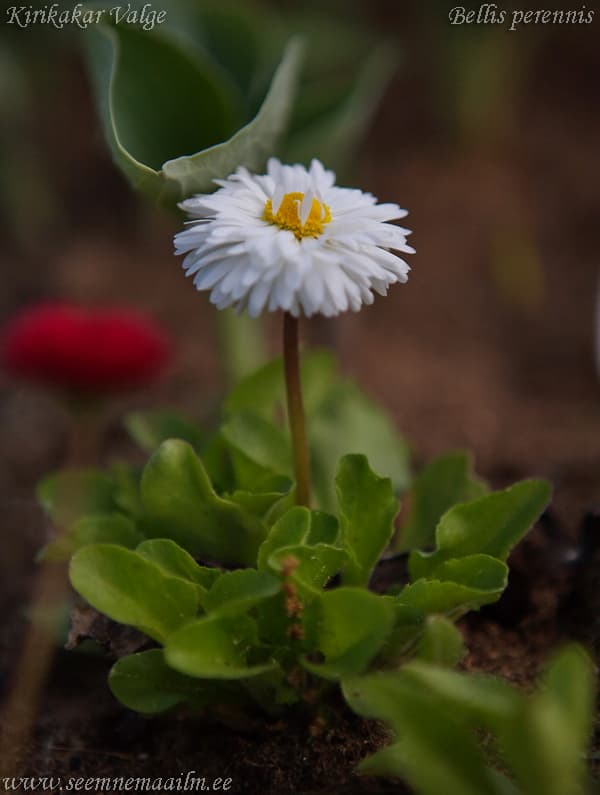
* It turns out that in the 18th century, a terrible danger threatened this lovely innocent flower!
It happened in Germany in 1739. The flower was falsely accused of being poisonous, and it was ordered to be destroyed everywhere. But whether because they did not zealously set about destroying it, or because the plant itself turned out to be incredibly resilient, the flower survived and continues to strew the flower beds of our spring gardens with numerous bright stars!